The American author Gretchen Rubin put a few-minute quiz online: "What's your Tendency?". Four possible answers, four profiles with names that stick (Upholder, Questioner, Obliger, Rebel).
Her site now claims more than 4.5 million people have taken it. The four profiles became a book, and a vocabulary her readers use to talk about themselves.
That's what a working quiz funnel looks like: a question people care about, an answer that feels like them, and a follow-up that comes from that answer.
And you don't need 4.5 million takers for it to pay off. You need a quiz, an email tool like Systeme.io, and a follow-up written profile by profile.
What is a quiz funnel?
A quiz funnel is a funnel whose first step is a quiz instead of a classic opt-in page.
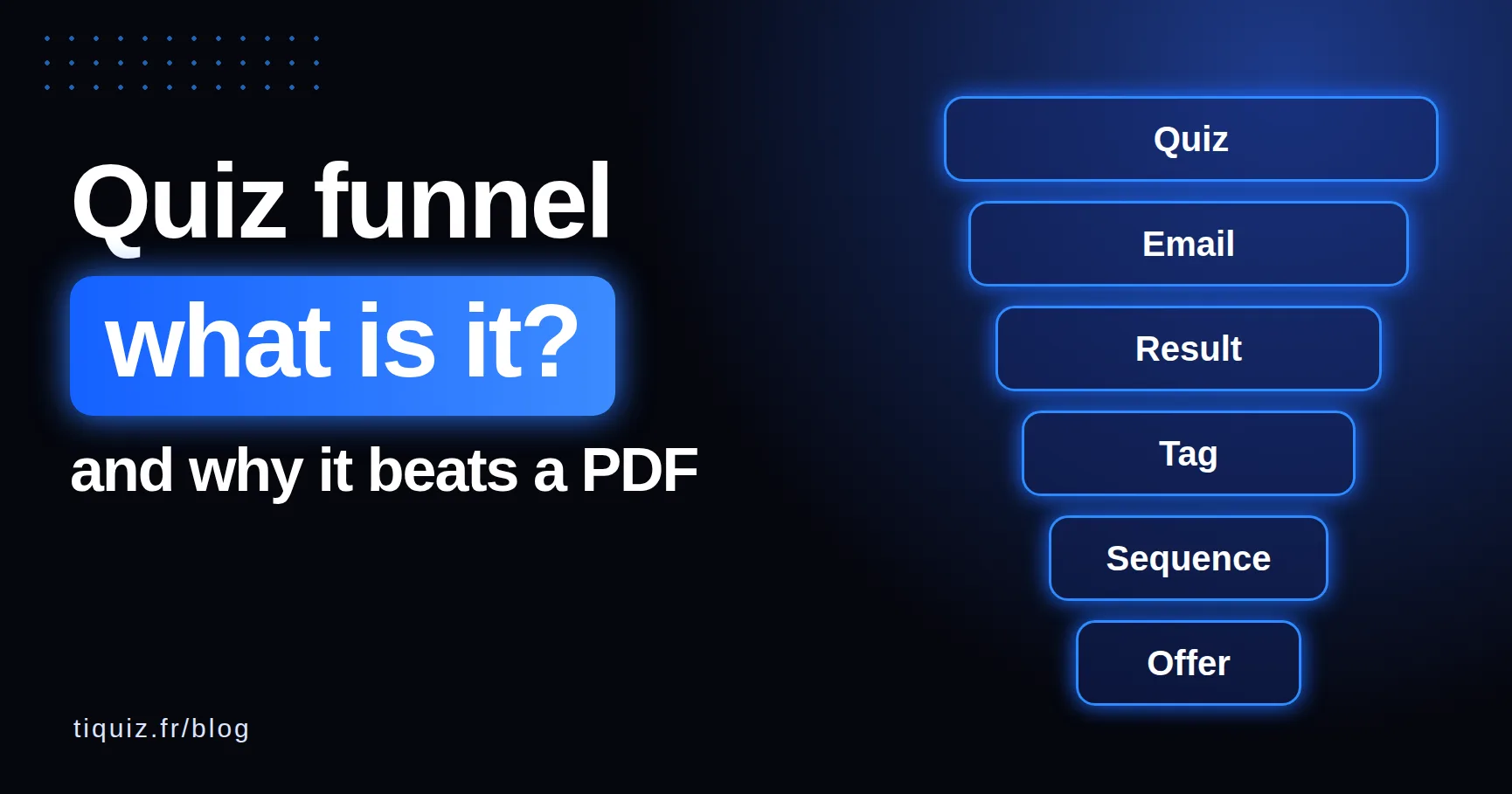
The full path fits in six steps:
- Someone lands on your quiz (from Instagram, your newsletter, a YouTube video, your website).
- They answer 5 to 10 questions about their situation.
- You ask for their email to send them their result.
- They see their result page: their profile, or their score.
- In your email tool, they get the tag for their profile.
- That tag triggers the email sequence written for that profile, with the offer that fits it.
Steps 5 and 6 are the ones most people forget. Without them, you have a quiz. With them, you have a funnel.

Quiz funnel vs PDF guide vs form: what really changes
The free PDF guide has proven itself, of course. It's quick to make and everyone understands what they're getting.
But it has two flaws a quiz doesn't: it speaks to everyone the same way, and it tells you nothing about the person downloading it.
| PDF guide | Contact form | Quiz funnel | |
|---|---|---|---|
| What they get | The same document as everyone | A reply later | A result about them, right away |
| What you learn about them | Their email | Whatever they chose to write | Their profile, their answers, their level |
| The emails that follow | One sequence for all | Case by case, by hand | One sequence per profile, automatic |
| Time to build | A few hours | A few minutes | A few minutes with Tiquiz, and on PLUS, the emails per profile generated for you |
Look at the second row: it changes everything. With a PDF, you get one more email on your list. With a quiz, you get a person whose profile, hesitation and words you know. And everything you write to them next lands right.
The 5 parts of a quiz funnel
1. A promise about them, not about you. "A quiz about stress management" promises nothing. "What's your stress profile (and how do you calm it)?" promises a personal result. People click because they want to learn something about themselves.
2. Questions that move forward. Easy at first, more engaging later. Every question should help tell the profiles apart: if a question changes nobody's result, it doesn't belong there (and it makes people leave).
3. The opt-in at the right moment. After the questions, before the result. They've already invested two minutes and they want THEIR answer: that's when they're most willing to leave their email. With a clear line: "Your detailed result is waiting."
4. A result page that feels like them. The mirror (you describe their situation in their words), the cause (what's really blocking them), the path (the steps), and only then the bridge to your offer. I detailed that structure in how to sell with a quiz.
5. One follow-up per profile. One tag per result in your email tool, one sequence per tag. The "Firefighter" profile doesn't get the same emails as the "Perfectionist" profile. That's where the money is made, and it's the part almost everyone skips.
Personality quiz or scored quiz: the first decision
Before writing a single question, pick the mechanism. Both work, just not for the same thing.
A personality quiz puts people in a profile: "You're more of a Firefighter, a Perfectionist or a Jack-of-all-trades". No profile is better than another. It's ideal when your clients have different problems and you have a different answer for each (a sequence, a module, an offer).
A scored quiz measures a level: "Your funnel is 40% ready". There's a bottom and a top. It's ideal for a diagnosis, when you want to show the gap between where they are and where they could be, and your offer closes that gap.
My rule of thumb: if you catch yourself writing "profile 3 is the best", it's a scored quiz. If each profile has its own strengths, it's a personality quiz.
Maurice, who uses Tiquiz for his client diagnosis quiz, summed it up in his review (translated from French): "connected to Systeme.io with email sequences segmented by profile. The connection is clean, the tags are applied automatically." Diagnosis on one side, one sequence per profile on the other: that's the whole idea.
What the numbers really say
You've probably read that a quiz converts "at 40%", or that it does "+743%". Both numbers exist. They don't mean what people make them say.
The question to always ask: 40% of what?
| Number | What it really measures | Who measured it |
|---|---|---|
| 40.1% | Of people who START a quiz leave their email | Interact, across all its customers' quizzes (updated September 2026) |
| 44.9% | Same measure, for coaching and course quizzes | Interact, same report |
| 65% | Of people who start make it to the end | Interact, same report |
| 7.85% | Of page VISITORS leave their details (11.28% on a dedicated quiz page) | ConvertFlow, across 1,063 customer campaigns (September 2026) |
40% and 8% are both true. The first counts from people who clicked "Start", the second from everyone who saw the page. In between are all the people who arrived and left without starting.
Two caveats, which I'd rather tell you straight:
- These numbers come from quiz software vendors measuring their own customers. Interact says so itself: they're averages observed on its platform, not a controlled experiment. I found no independent study.
- The famous +743% doesn't come from a quiz. It's the agency Venture Harbour turning ITS contact form into a multi-step form, then optimizing it for about five years. Interesting, but it's not a quiz funnel.
What you can take from this without fooling yourself: on the platform that publishes the most data, about four in ten people who start a quiz leave their email. And to know where YOUR quiz loses people, there's only one way: look at your own numbers, question by question.
Quiz funnels that worked (and what to learn from them)
Gretchen Rubin, "The Four Tendencies". More than 4.5 million takers claimed. The result doesn't ask for an email: it's the profile vocabulary that brings people back, then the book. Lesson: profile names people want to repeat.
Jenna Kutcher and Chanti Zak. Jenna Kutcher, an American creator and podcaster, writes on her blog, in a post about quiz specialist Chanti Zak, that quizzes brought her more than 100,000 email subscribers. Chanti Zak's very first quiz, about chakras, reportedly brought her 10,000 subscribers in a month. Lesson: a generous result that really gives something, then a sequence that leads to an offer.
Typology, the French skincare brand, offers an online skin diagnosis of about fifteen questions that ends with a recommended routine (according to press coverage of its success). Lesson: the quiz IS the advice, the product only comes at the end.
Jocelyne, in France. The author of 70 novels, she started a new business from scratch in a niche where nobody knew her. In 9 days, her Tiquiz quiz brought her 285 qualified readers. I wrote up her whole case, numbers included.
After the quiz: one tag per result, one sequence per profile
This is the part most articles on the topic skim over, and it's the one that turns leads into clients.
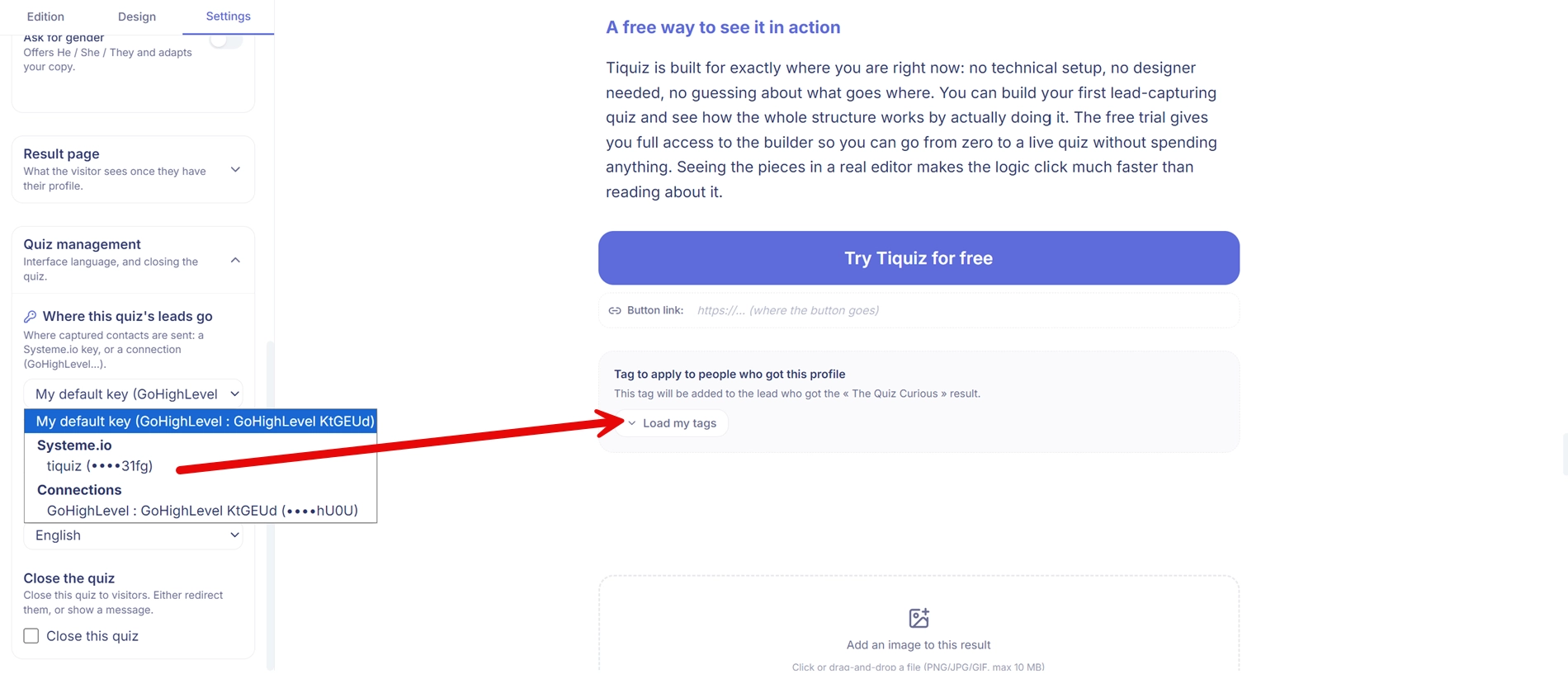
In practice, in Systeme.io:
- Each result profile has its tag (for example
quiz-firefighter,quiz-perfectionist). - When someone finishes the quiz, the contact is created in Systeme.io with their profile's tag.
- A "Tag added" automation rule enrolls them in the email campaign written for that profile.
With Tiquiz, the first two steps happen on their own: you pick each profile's tag in the quiz, and Tiquiz creates the contact, creates the tag if it doesn't exist yet, and applies it. No Zapier, no Make, from the free plan. All that's left is creating the rule and the campaign in Systeme.io. It works the same way with GoHighLevel.
I walked through every screen in Systeme.io quiz funnel: 3 ways to build it, and the rules to create in Systeme.io automation: the 5 rules to set up for every lead.
Still unsure which quiz tool to pick? I went through the most popular ones, real prices included: Tally, ScoreApp and Jotform.
"I only have one offer": why the quiz still works
It's the objection I hear most often. "A profile quiz is for people with several offers. I have one programme, for one type of client."
And that's exactly where the quiz is most useful.
One offer doesn't mean one kind of person. Your clients want the same outcome, but they don't come for the same reasons, they don't get stuck in the same place and they don't use the same words. One is afraid of not having the time. Another has tried everything and no longer believes it can work. A third wants to move fast and hates being lectured.
The quiz tells you who's who. Then you talk about the SAME offer, with the angle that lands for each one: their goal, their pain, their hesitation, in their own words. That's the difference between an email people read thinking "that's me", and one they delete.
"I don't have time to write one sequence per profile." By hand, it's real work. That's why Tiquiz PLUS generates each profile's emails and the bonus to offer, from your quiz. You review, add your touch, and publish.
"A PDF is simpler." A PDF takes five minutes with an AI, and that's exactly the problem: your prospect already has ten of them in their downloads, and it tells you nothing about them. The quiz talks to them about themselves, tells you who they are, and files every lead in the right place on its own. A PDF will never do that.
The mistakes that kill a quiz funnel
A result anyone could get. "You have great potential, keep it up!" They gave you their email for that? They won't read your next emails.
Asking for the email without promising anything. "Enter your email" isn't enough. "Your detailed result and your first three actions are waiting" gives a reason.
The same email for everyone. You made the effort to sort your leads, then you send them all the same newsletter. All the quiz's work is lost.
Too many questions that serve no purpose. Every question that changes no result makes people leave. One question to ask for each: if I remove it, does a single result change?
Never looking at where people drop off. One user saw, thanks to question-by-question tracking, that her question 2 was driving people away. She swapped two questions and her completion rate went up, without a single extra visitor.
Your first quiz funnel, this week
You're now ahead of most people who talk about quiz funnels: you know the quiz is only the door, and that everything happens in the follow-up.
So don't chase perfection. Chase the first step:
- Pick ONE question your prospects ask about themselves. "Why can't I...", "What's my ... profile".
- Build your quiz on Tiquiz, for free: the AI writes the questions and profiles from your topic, you review and put it in your own words.
- Connect Systeme.io and pick each profile's tag.
- Write one first email per profile. One is enough to start: the one that tells the person "I get you, here's your next step".
Your quiz can be live today. Your sequence will grow over the weeks, built on what your first leads teach you.
FAQ · the quiz funnel
What is a quiz funnel, in one sentence?
A sales funnel whose front door is a quiz: people answer, leave their email to see their result, get a tag based on their profile, then the emails and offer that fit that profile.
How many questions should a quiz funnel have?
There's no serious consensus: the recommendations you'll find range from 5 to 12. The better rule is simpler: keep the questions that tell your profiles apart, remove the ones that change no result.
Should you ask for the email before or after the result?
Before the result, after the questions. That's when people most want to know, so that's when they're most willing to leave their email. With a line that says what they'll get.
What's the difference between a quiz funnel and a lead magnet?
The quiz IS a lead magnet, but one that talks about the person instead of about you. And it tells you who they are, which a PDF never does.
What's a good conversion rate for a quiz funnel?
It depends on what you count. On the Interact platform, about 40% of people who start a quiz leave their email (44.9% for coaching). Measured against all page visitors, ConvertFlow reports 7.85% on average and 11.28% on a dedicated page. These are vendor numbers, measured on their own customers.
Can you build a quiz funnel in Systeme.io?
Systeme.io has a Survey element that applies a tag per answer, but it doesn't calculate a profile or a score and doesn't show a result page. For a real quiz funnel, you need a quiz tool connected to Systeme.io, like Tiquiz, which applies the profile's tag directly.
How much does a quiz funnel cost?
It can cost nothing: Tiquiz has a free plan, no credit card and no time limit, that lets you build your first quiz and connect it to Systeme.io. What it costs is your time to write the results and the sequences.
Want to build the whole system around the quiz (one sequence per profile, the sale at the end)? I walk you through it in how to sell with a quiz.
Sources
- Gretchen Rubin, The Four Tendencies Quiz: gretchenrubin.com
- Interact, "Quiz Conversion Rate Report" (updated September 8, 2026): tryinteract.com
- ConvertFlow, "Lead Generation Quiz Funnel Benchmark" (September 2026): convertflow.com
- Venture Harbour, case studies (the +743% form): ventureharbour.com
- Jenna Kutcher, on Chanti Zak: jennakutcherblog.com
- Paris Match Belgium, on Typology (December 2024, in French): parismatch.be